 By
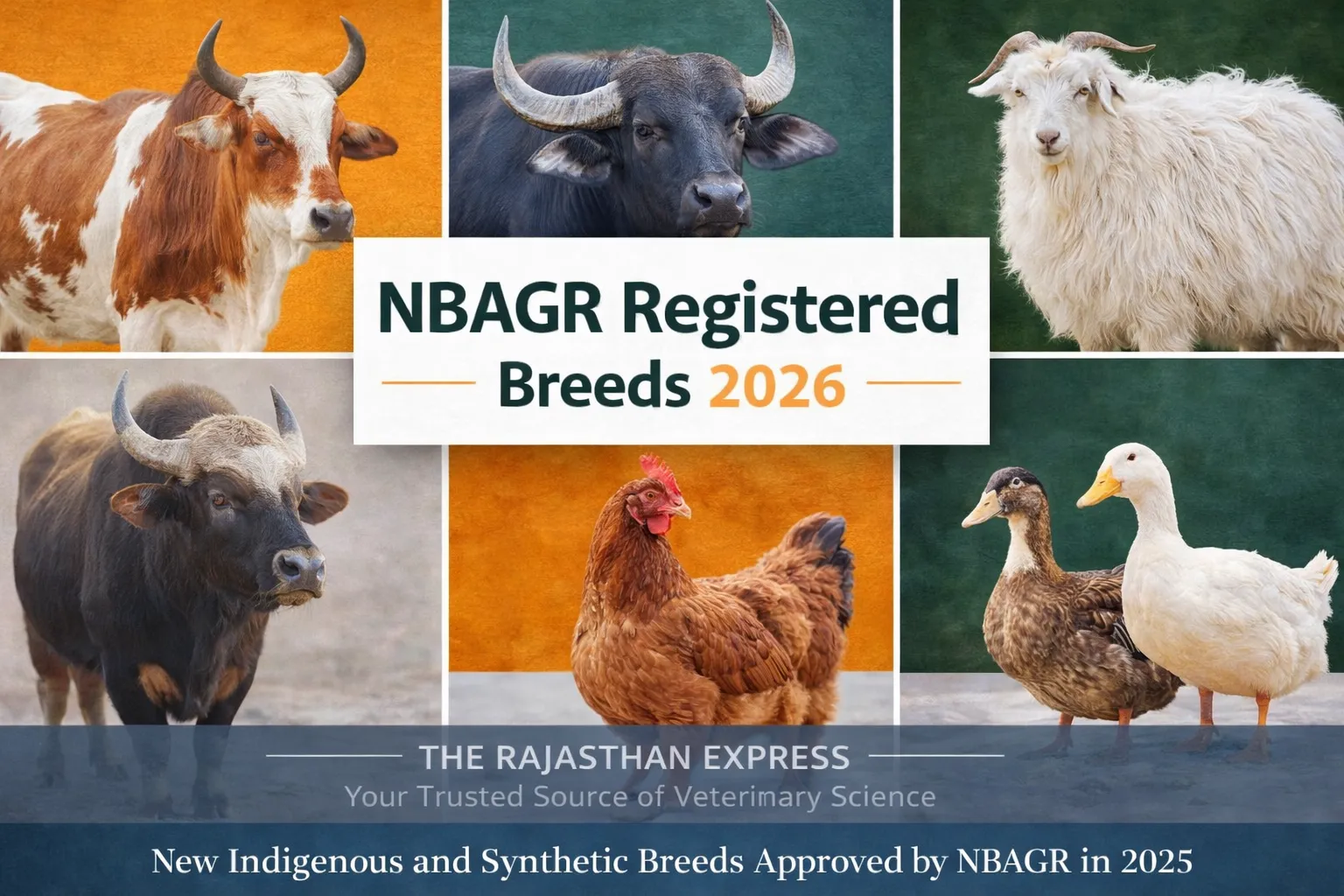
ByNBAGR Registered Breeds 2026: New and Registered Indigenous Livestock Breeds of India
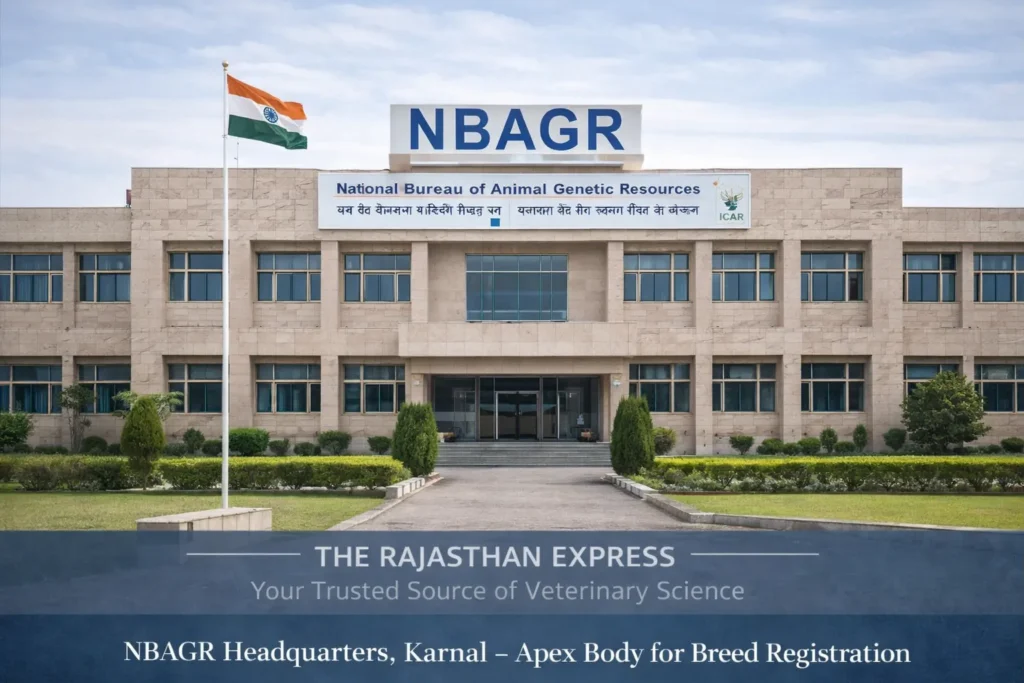
India’s indigenous livestock and poultry breeds are officially registered by National Bureau of Animal Genetic Resources (NBAGR). The headquarters of NBAGR (National Bureau of Animal Genetic Resources) is located in Karnal, Haryana.
A committee has been constituted under the chairmanship of the Deputy Director General (DDG), Animal Science, of Indian Council of Agricultural Research (ICAR), known as the Breed Registration Committee (BRC). It is the highest authority for the registration of new animal species and breeds in the country. This committee approves new livestock and poultry breeds in India.
NBAGR Registered Indigenous & Synthetic Breeds of India (2026 Comprehensive Update)
| Official Authority | ICAR – National Bureau of Animal Genetic Resources (NBAGR) |
|---|---|
| Headquarters | Karnal, Haryana, India |
| Programme Name | Animal Germplasm Registration Programme |
| Programme Initiated | 2007 |
| First Complete Breed Registration | 2008 (All 129 existing breeds documented and registered) |
| Highest Registration Authority | Breed Registration Committee (BRC) |
| Chairperson of BRC | Deputy Director General (Animal Science), ICAR |
| BRC Composition |
• Assistant Director Generals (ICAR) • Animal Husbandry Commissioner / Representative • National Biodiversity Authority Representative • Director, NBAGR (Member) |
| Registration Criteria |
• Minimum 1,000 animals required • Distinct phenotypic & genetic characteristics • Defined native tract • Community-based recognition |
| Total Indigenous Breeds (Feb 2026) | 242 |
| Total Synthetic Breeds | 4 (3 Synthetic Cattle + 1 Synthetic Sheep) |
| Total Registered Breeds (Overall) | 246 |
| New Breeds Approved – 12th BRC | 6 January 2025 (NASC, New Delhi) – 10 Breeds |
| New Breeds Approved – 13th BRC | 12 November 2025 (New Delhi) – 13 Indigenous + 3 Synthetic |
| Total New Breeds Registered (2015–2026) | 94 Breeds |
| Geographical Coverage | 400 Districts, 24 States & 3 Union Territories |
| Total Estimated Population of Registered Breeds | ~170 Lakh (≈1.7 Crore Animals & Birds) |
| Beneficiary Farmers | 30–40 Lakh (Majority Small, Marginal & Landless Farmers) |
| Primary Objectives of Registration |
• Conservation of indigenous genetic resources • Prevention of genetic erosion • Official breed recognition • Community pride & identity protection • Scientific documentation & characterization • Support for breed improvement programmes |
| Legal & Institutional Significance |
• Official national recognition of breed identity • Strengthens biodiversity protection framework • Ensures traceability and genetic purity documentation • Supports livestock-based rural economy |
| Socio-Economic Impact |
• Enhances farmer income opportunities • Promotes region-specific sustainable livestock systems • Supports climate-resilient animal farming • Encourages value addition and branding |
| The Rajasthan Express: Your Trusted Source for Animal Care and Veterinary Science. | |
NBAGR Registered New Breeds: 12th and 13th BRC Meetings (2025)
The 12th meeting of the Breed Registration Committee (BRC) was held on 6 January 2025 at NASC, New Delhi. In this meeting, under the chairmanship of Dr. Raghavendra Bhatta (DDG, Animal Science), 10 new livestock and poultry breeds from different states were approved.
Subsequently, the 13th meeting was held on 12 November 2025 in New Delhi. In this meeting, 13 indigenous (native) and 3 synthetic breeds were approved.
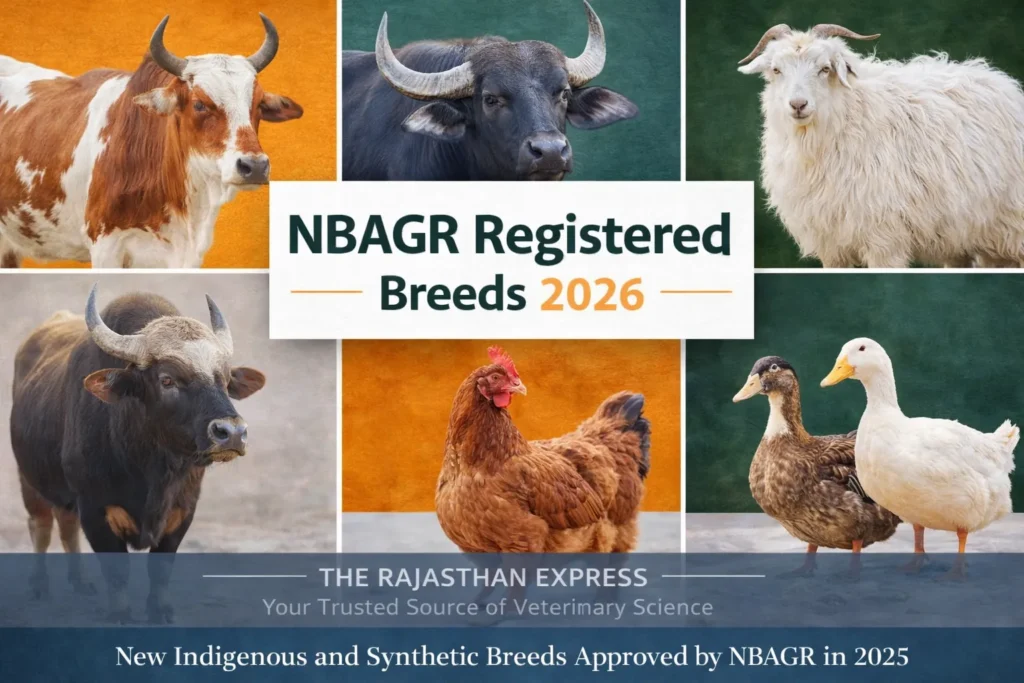
Major Breeds Approved in November 2025
The major breeds approved in November 2025 include:
- Medini Cattle (Jharkhand)
- Rohilkhandi Cattle (Uttar Pradesh)
- Melghati Buffalo (Maharashtra)
- Palamu Goat (Jharkhand)
- Udaypuri Goat (Uttarakhand)
- Nagami Mithun (Nagaland)
- Mala Chicken (Jharkhand)
- Kodo Duck (Jharkhand)
- Kudu Duck (Odisha)
- Kuttanad Duck (Kerala)
- Manipuri Duck (Manipur)
- Nagi Duck (Assam)
- Rajdigheli Goose (Assam)
In addition, the following synthetic breeds were also approved:
- Karan Fries Synthetic Cow (Haryana)
- Vrindavani Synthetic Cow (Uttar Pradesh)
- Avishan Synthetic Sheep (Rajasthan)
| 12 Nov 2025 – Registered New Breeds | ||||
| S.N. | Species | Breed | Native Tract | Accession Number |
|---|---|---|---|---|
| 1 | Cattle | Medini | Jharkhand | INDIA_CATTLE_2500_MEDINI_03054 |
| 2 | Cattle | Rohilkhandi | Uttar Pradesh | INDIA_CATTLE_2000_ROHILKHANDI_03055 |
| 3 | Buffalo | Melghati | Maharashtra | INDIA_BUFFALO_1100_MELGHATI_01022 |
| 4 | Goat | Palamu | Jharkhand | INDIA_GOAT_2500_PALAMU_06042 |
| 5 | Goat | Udaipuri | Uttarakhand | INDIA_GOAT_2400_UDAIPURI_06043 |
| 6 | Mithun | Nagami | Nagaland | INDIA_MITHUN_1400_NAGAMI_08001 |
| 7 | Chicken | Mala | Jharkhand | INDIA_CHICKEN_2500_MALA_12021 |
| 8 | Duck | Kodo | Jharkhand | INDIA_DUCK_2500_KODO_11005 |
| 9 | Duck | Kudi | Odisha | INDIA_DUCK_1500_KUDU_11006 |
| 10 | Duck | Kuttanad | Kerala | INDIA_DUCK_0900_KUTTANAD_11007 |
| 11 | Duck | Manipuri | Manipur | INDIA_DUCK_1200_MANIPURI_11008 |
| 12 | Duck | Nagi | Assam | INDIA_DUCK_0200_NAGI_11009 |
| 13 | Geese | Rajdigheli | Assam | INDIA_GEESE_0200_RAJDIGHELI_18002 |
| 14 | Synthetic Cattle | Karan Fries | Haryana | INDIA_CATTLESYNTHETIC_0500_KARANFRIES_04002 |
| 15 | Synthetic Cattle | Vrindavani | Uttar Pradesh | INDIA_CATTLESYNTHETIC_2000_VRINDAVANI_04003 |
| 16 | Synthetic Sheep | Avishaan | Rajasthan | INDIA_SHEEPSYNTHETIC_1700_AVISHAAN_15001 |
| The Rajasthan Express: Your Trusted Source for Animal Care and Veterinary Science. | ||||
NBAGR Registered Breeds Total in India (2026 Update)
By the end of 2024, a total of 220 breeds were registered in India. After the addition of 10 new breeds in January 2025, this number increased to 230.
By February 2026, a total of 242 indigenous livestock and poultry breeds have been registered in the country. In addition, 3 crossbred cow breeds and 1 crossbred sheep breed have also been registered.
| Indigenous Livestock Breeds Registered So Far (Total: 242) | ||
| S. No. | Animal Species | Number of Registered Breeds |
|---|---|---|
| 1 | Cattle | 55 |
| 2 | Buffalo | 22 |
| 3 | Goat | 43 |
| 4 | Sheep | 46 |
| 5 | Horse & Pony | 8 |
| 6 | Camel | 9 |
| 7 | Pig | 15 |
| 8 | Donkey | 4 |
| 9 | Dog | 5 |
| 10 | Yak | 2 |
| 11 | Chicken | 21 |
| 12 | Duck | 9 |
| 13 | Geese | 2 |
| 14 | Mithun | 1 |
| Total (Indigenous Breeds) | 242 | |
| The Rajasthan Express: Your Trusted Source for Animal Care and Veterinary Science. | ||
| Registered Synthetic Breeds | ||
| S. No. | Animal Species | Number of Registered Synthetic Breeds |
|---|---|---|
| 1 | Synthetic Cattle | 3 |
| 2 | Synthetic Sheep | 1 |
| Total (Synthetic Breeds) | 4 | |
| The Rajasthan Express: Your Trusted Source for Animal Care and Veterinary Science. | ||
Key Findings:
- Total Registered Breeds (Without Synthetic Breed): 242
- Total Synthetic Breeds: 4
In 2008, the registration of all 129 breeds existing at that time was completed. The registration of indigenous livestock and poultry breeds directly benefits farmers and others associated with animal husbandry.
Why NBAGR Registered Breeds Are Important
It is very important to maintain proper records of the unique and useful animal breeds found in the country. For this reason, ICAR initiated the “Animal Germplasm Registration” process in 2007. The responsibility for this work was assigned to NBAGR, Karnal.
ICAR–National Bureau of Animal Genetic Resources (NBAGR), Karnal, has been designated as the nodal agency for this task. A special committee called the Breed Registration Committee (BRC) has been formed for the registration of animal breeds in the country. This committee is chaired by the Deputy Director General (Animal Science), ICAR.
The committee includes:
- Assistant Director Generals of ICAR
- Animal Husbandry Commissioner or their representative
- Representative of the National Biodiversity Authority
- Director of NBAGR as a member
This is the only recognized official process for registering any indigenous breed, synthetic breed, or any specific strain in the country.
Why Breed Registration Is Necessary
When a breed is registered, a sense of pride and belonging increases among the local communities who have preserved and maintained that breed for generations. It also helps in the conservation and further development (improvement) of the breeds.
Achievements in the Last 11 Years (2015–16 to 2025–26)
In the last 11 years, a total of 94 new animal breeds have been registered. These include:
- 19 Cattle
- 8 Buffalo
- 7 Sheep
- 19 Goat
- 12 Pig
- 2 Horse
- 3 Donkey
- 2 Yak
- 5 Chicken
- 9 Duck
- 2 Goose
- 5 Dog
- 1 Mithun
All these registered breeds are found in approximately 400 districts across 24 states and 3 Union Territories of the country.
The total population of these breeds is approximately 170 lakh (around 1.7 crore) animals and birds. These are reared by about 30 to 40 lakh farmers, most of whom belong to landless, small, or marginal categories.
Condition for Breed Registration
For the registration of any breed, it is mandatory that at least 1,000 animals of that breed must exist. Only then is it officially recognized for registration.
Key Points About Indigenous Cows in India (Desi Cow Facts)
- India’s best draught (load‑carrying) breed is Amrit Mahal.
- Maharashtra’s best draught breed is Khillari.
- Rajasthan’s best load‑carrying breed is Nagori.
- India’s best dual‑purpose (milk + work) breed is Hariana.
- The world’s smallest cow breed is Vechur.
- India’s heaviest cow breed is Kankrej.
- The Kankrej breed exhibits a “Sawai Chal” (fast and special gait).
- Deoni cow was created by crossing Gir, Dangi, and local cows.
- Nimari cow was created by mixing Gir and Khillari breeds.
- India’s most expensive cow breed is considered to be Ongole. In Brazil, this same breed is called Nelore. At the beginning of the year 2025, a Nelore cow named “Viatina‑19” was sold for approximately ₹40‑41 crore. It also set a Guinness World Record. “Viatina‑19” weighed about 1100 kg, which is much more than a normal cow. The first Ongole cows were taken from India to Brazil in 1868. Later, by 1960, about 7000 cattle were sent there. In Brazil, this breed was named “Nelore”, after the Nellore district of Andhra Pradesh.
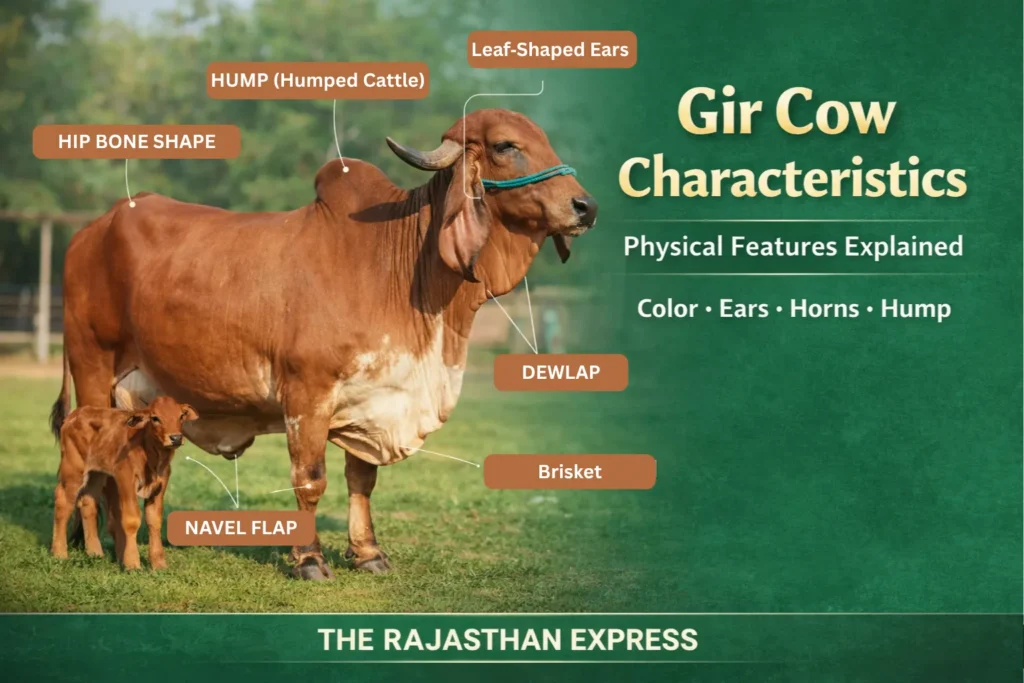
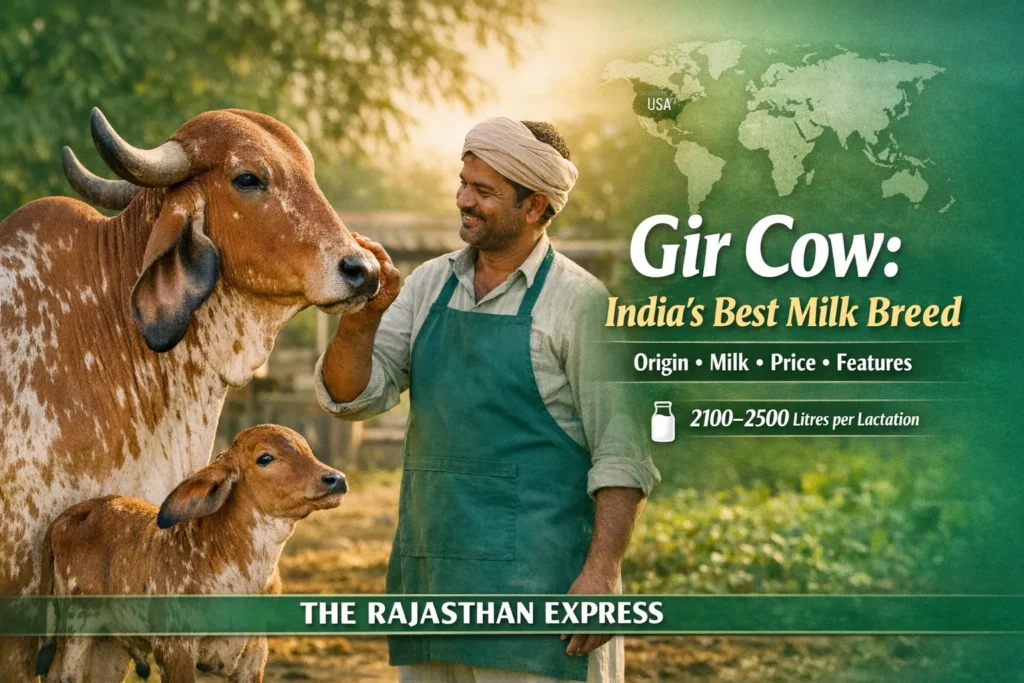
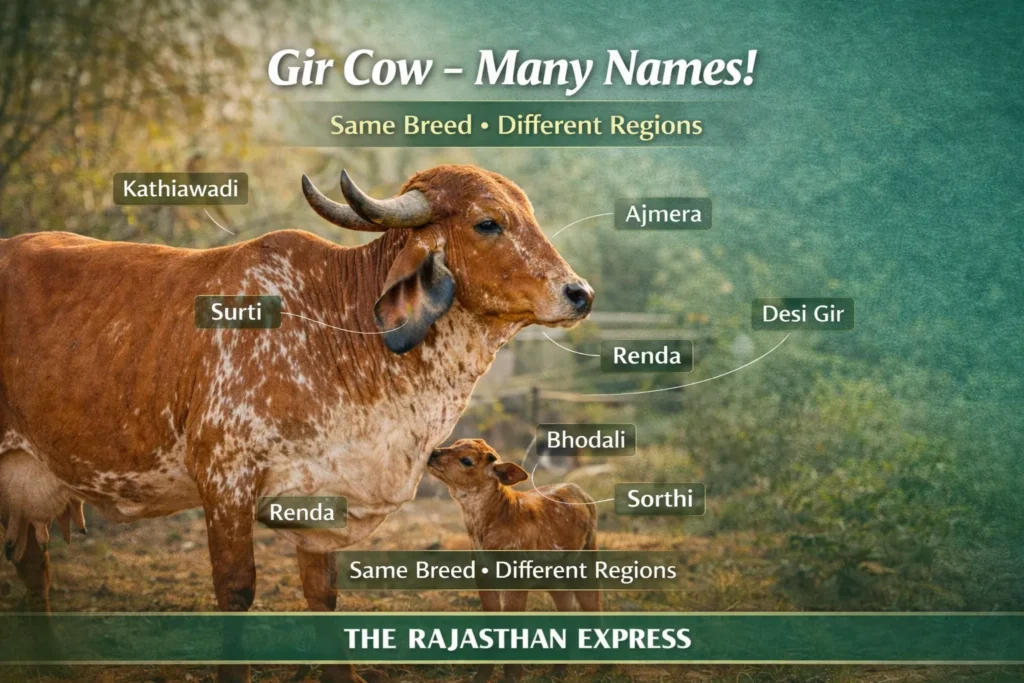
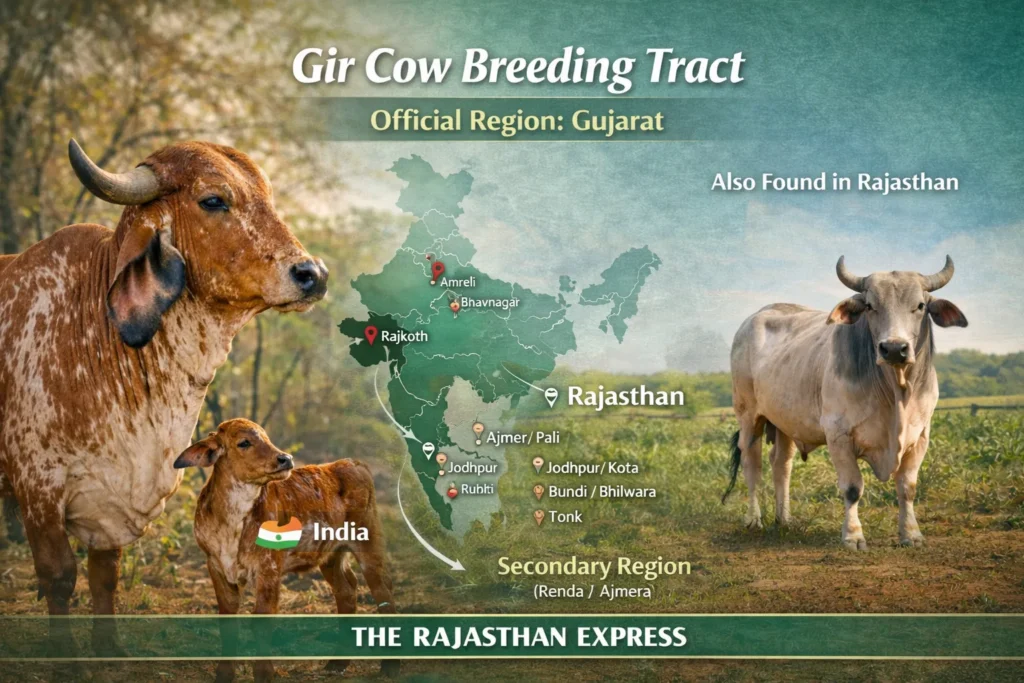
- Among indigenous cows, the longest lactation period is of the Gir cow (about 325 days). The Gir cow originated in the Gir forests of Kathiawar, Gujarat. The Gir cow is also called Kathiyawadi, Ajmera, Renda, Surti.
- Among buffaloes, the longest lactation period is of the Mehsana buffalo (about 352 ± 15 days).
- Identification of Gir cow:
- Red, brown, or spotted skin
- Prominence on forehead
- Long, hanging, leaf‑shaped ears
- Half‑moon shaped horns
- India’s highest milk‑producing indigenous cow is Sahiwal.
- In the Sahiwal cow, the dewlap (loose skin of the neck) and Nawelflap are more developed. This is the main identification of the Sahiwal cow. The Sahiwal cow originated in Montgomery (Pakistan), Punjab, Haryana. The Sahiwal cow is also called Lola breed, Multani, Montgomery, Lambi Bar.
- Because the Sahiwal cow’s skin is loose, it is also called the Lola breed.
- The most intelligent cow breed is considered to be Red Sindhi. The Red Sindhi cow originated in Karachi, Hyderabad (Sindh), Pakistan. The Red Sindhi cow is also called Red Karachi.
- Among indigenous breeds, the highest disease resistance is found in the Tharparkar cow, which is found in the state of Rajasthan, India. The Tharparkar cow originated in the Tharparkar district of Sindh province in Pakistan and in Gudamalani, Barmer. It is also known as White Sindhi, Grey Sindhi, or Thari and Malani. This breed is named after the Thar Desert, which extends from Sindh to the Kutch district of Gujarat and to the Barmer, Jaisalmer, and Jodhpur districts of Rajasthan, India.
- The Tharparkar cow also has the ability to change colour.
- The highest milk‑producing cow in Rajasthan is Tharparkar.
- The Rathi cow was created by mixing Red Sindhi, Sahiwal, Tharparkar, and Dhani breeds. The Rathi cow is also called Rajasthan’s Kamadhenu.
NBAGR Registered New Breeds 2026: Detailed Profile of Newly Approved Livestock & Poultry Breeds
The following indigenous and synthetic breeds have been registered as per the latest NBAGR update (2026).
1. Rohilkhandi Cattle (NBAGR Cattle Breeds – Uttar Pradesh)
Rohilkhandi cattle are mainly found in the Bareilly, Badaun, and Pilibhit districts of Uttar Pradesh. Their color is mostly white or grey. The face is narrow, flat, or slightly depressed, and the eyelids are white in color.
The horns are generally curved outward and upward and are pointed at the tips. The tail is long. The forehead is straight and prominent.
The bulls of this breed are relatively tall and possess very good draft power.
Average Milk Production: Approximately 5.21 kg per day
Average Lactation Period: 210 days
Estimated Population: Approximately 3 lakh
2. Medini Cattle (NBAGR Registered Cattle Breeds – Jharkhand)
The native tract of Medini cattle includes Palamu, Latehar, Garhwa, and nearby districts of Jharkhand. It is a medium-sized cattle breed and is mainly used for ploughing work.
The color is mostly grey. The muzzle, eyelids, hooves, and tail switch are black. The forehead is flat, and the ears are erect.
In this breed, the hump is located in the pre-scapular region (in front of the shoulder). These animals adapt well to the climatic and farming conditions of the region and are mostly reared on grazing.
Average Milk Production: Approximately 1.6 kg per day
Bulls can plough continuously for: 7–8 hours
Estimated Population: Approximately 14 lakh
3. Melghati Buffalo (NBAGR Buffalo Breeds – Maharashtra)
Melghati buffalo is found in the Melghat region of Amravati district, Maharashtra. It is black in color and has more body hair.
The forehead is broad and dome-shaped. The face is long and thin. The nasal bone is sharp, and the eyes are prominent.
The horns are curved backward parallel to the body and then turn upward or inward, becoming pointed.
Average Milk Production: Approximately 4 kg per day
Maximum (Peak) Milk Production: Approximately 10 kg per day
Milk Fat Percentage: Approximately 7%
Estimated Population: Approximately 28 thousand
4. Palamu Goat (NBAGR Goat Breeds – Jharkhand)
Palamu goat is mainly found in Palamu, Latehar, and Garhwa districts of Jharkhand. It appears relatively tall and is medium-sized. The body is cylindrical in shape.
The color usually ranges from dark brown to black. The ears are drooping (dropping type). This breed is mainly used for meat production.
Adult Male Weight: Approximately 26 to 34 kg
Adult Female Weight: Approximately 19 to 28 kg
These goats adapt well to the climatic and farming conditions of the region and are mostly reared on grazing. Farmers prefer them due to their hardiness and good commercial returns.
Estimated Population: Approximately 5.7 lakh
5. Udaipuri Goat (NBAGR Goat Breeds – Uttarakhand)
The native tract of Udaipuri goat is in Pauri Garhwal district of Uttarakhand. It is a medium-sized, compact-bodied goat with more body hair.
The color is light brown (tan) with a black stripe along the dorsal line. Black hair is present on the forehead, and the head is slightly convex.
The ears are pendulous. Beard and wattles are absent. The horns are medium-sized, flat, pointed, and curved outward or backward.
This breed is mainly used for meat.
Average Adult Male Weight: Approximately 26 kg
Estimated Population: Approximately 25 thousand
6. Nagami Mithun (NBAGR Species – Mithun, Nagaland)
Nagami Mithun is found in Kohima, Peren, Chümoukedima, Zunheboto, Phek, Tuensang, Kiphire, Noklak, Shamator, Mon, Wokha, Tseminyu, and Longleng districts of Nagaland.
The body is strong, compact, and muscular. Most animals are black in color with white stockings on the lower parts of the legs. Some animals show white patches or a spotted pattern.
The face is inverted triangular in shape, and the forehead is straight. The line joining the base of both horns is straight. A prominent dorsal ridge is visible in both males and females.
The horns are thick and rough at the base, first projecting outward and then curving upward to become pointed.
It is mainly used for meat and as a sacrificial animal in traditional ceremonies.
Male Weight: Approximately 470 to 500 kg
Female Milk Yield: 184 to 193 kg in about 300 days of lactation
Estimated Population: Approximately 23 thousand
Nagami Mithun holds great social, economic, and cultural importance among local farmers.
7. Mala Chicken (NBAGR Registered Poultry Breeds – Jharkhand)
Mala chicken is mainly found in Ranchi and Khunti districts of Jharkhand. The plumage color is black-golden mixed or white-black mixed.
In males, the neck and back feathers are golden yellow, forming a garland-like appearance. Hence, it is called “Mala Chicken.”
Average Annual Egg Production: Approximately 67 eggs (with brooding tendency)
High survivability even under low-input conditions
Adult Male Weight: Approximately 1.9 kg
Adult Female Weight: Approximately 1.1 kg
Estimated Population: Approximately 1.6 lakh
8. Kodo Duck (NBAGR Registered Duck Breeds – Jharkhand)
Kodo duck is a local breed of West Singhbhum, Saraikela-Kharsawan, Ranchi, and Pakur districts of Jharkhand.
The plumage is black-white or brown-white. Many birds have green-black beaks. The shank and webbed feet are mostly orange.
The body is slightly upright, and the beak is straight and horizontal.
Use: For both egg and meat
Annual Egg Production: Approximately 40 to 90 eggs
Good survivability in low-cost systems
Estimated Population: Approximately 42 thousand
9. Kudu Duck (NBAGR Duck Breeds – Odisha)
Kudu duck is a local breed of Mayurbhanj district of Odisha.
The plumage is light brown with a mosaic pattern. A white ring is present around the neck. The beak, legs, and feet are orange.
Use: For both egg and meat
Average Annual Egg Production: Approximately 149 eggs
Average Egg Weight: Approximately 64 grams
Adult Male Weight: Approximately 1.3 kg
Adult Female Weight: Approximately 1.2 kg
Estimated Population: Approximately 64 thousand
10. Kuttanad Duck (NBAGR Registered Breeds – Kerala)
Kuttanad duck is found in Alappuzha, Kottayam, and Pathanamthitta districts of Kerala.
Two color varieties are observed:
- Chara – Black-brown plumage
- Chemballi – Light and mixed-colored plumage
In the Chara type, the beak is light orange, while in Chemballi it is yellow. Black spots are also visible on the beak.
Annual Egg Production (Semi-Intensive System): Approximately 200–210 eggs
Average Egg Weight: Approximately 69 grams
Adult Weight: Approximately 1.6 to 2 kg
Use: Dual-purpose (egg and meat)
Estimated Population: Approximately 17.8 lakh
This breed is also considered very useful in the “duck-rice” integrated system due to its good grazing ability.
11. Manipuri Duck (NBAGR Duck Breeds – Manipur)
Manipuri duck is found in Imphal West, Imphal East, Thoubal, Kakching, Bishnupur, Jiribam, and other hill districts of Imphal Valley in Manipur.
Female ducks have light to dark brown spotted plumage. The male (drake) has a bright green head, while the body is light to dark slate-colored.
The beak is mostly yellow to dark green with a black tip.
Use: For both egg and meat
Average Egg Production: Approximately 130 eggs in 6–7 months laying period
Adult Male Weight: Approximately 1.8 to 2.4 kg
Estimated Population: Approximately 17.8 lakh
12. Nagi Duck (NBAGR Registered Duck Breeds – Assam)
Nagi duck is a local breed of Cachar, Karimganj, and Hailakandi districts of Assam. It is medium-sized with a cylindrical body.
The color is predominantly black. Many birds have a white patch on the chest.
Use: Dual-purpose (egg and meat)
Shank Color: Light grey with an orange tinge
Annual Egg Production: Approximately 150–180 eggs
The eggs of Nagi duck have a light green-blue shell (instead of white) and are considered more nutritious.
Adult Male Weight: Approximately 1.5 to 1.7 kg
Estimated Population: Approximately 68 thousand
13. Rajdigheli Geese (NBAGR Registered Breeds – Assam)
Rajdigheli, also known as “Rajhans,” is found in almost all districts of Assam.
It is a heavy-bodied goose with a long neck. The plumage is mainly found in two colors—white and cinnamon. Some birds show black or mixed coloration.
Beak Color: Mostly orange or yellow
Legs and Feet: Orange or yellow
Some geese have a knob on the forehead
Use: Meat, egg, ornamental, and religious purposes
Adult Male Weight: Approximately 3.9 kg
Adult Female Weight: Approximately 3.6 kg
Average Egg Production: Approximately 19 eggs per year
Average Egg Weight: Approximately 116 grams
Estimated Population: Approximately 3 lakh
NBAGR Synthetic Breeds 2026
14. Karan Fries (Synthetic Cattle Breed)
Karan Fries is a synthetic cattle breed developed by ICAR–National Dairy Research Institute (NDRI).
It is found in Karnal, Kurukshetra, Panipat, Kaithal, Jind, and Yamunanagar districts of Haryana.
It was developed by crossing Holstein Friesian (HF) and Tharparkar breeds. Approximately 62.5% HF and 37.5% Tharparkar blood level has been stabilized.
Body Color: Black and white
No hump
Average Milk Yield: Approximately 3550 kg per lactation
Production in 305 Days: Approximately 5851 kg
Maximum (Peak) Milk Production: Approximately 46.5 kg per day
This breed is well adapted to hot and humid subtropical climates.
Estimated Population: Approximately 20 thousand
15. Vrindavani (Synthetic Cattle Breed)
Vrindavani synthetic cattle has been developed by ICAR–Indian Veterinary Research Institute (IVRI).
It is found in Bareilly, Pilibhit, Shahjahanpur, and Badaun districts of Uttar Pradesh.
It has been developed by crossing four different breeds. Approximately 39.5% Holstein Friesian (HF), 26.9% Hariana, 22% Jersey, and 10.7% Brown Swiss blood level has been stabilized.
Body Color: Mostly brown
Forehead: Slightly concave
Ears: Medium-sized with rounded margins
Average Milk Yield: Approximately 3000 to 3500 kg per lactation
Estimated Population: Approximately 10 thousand
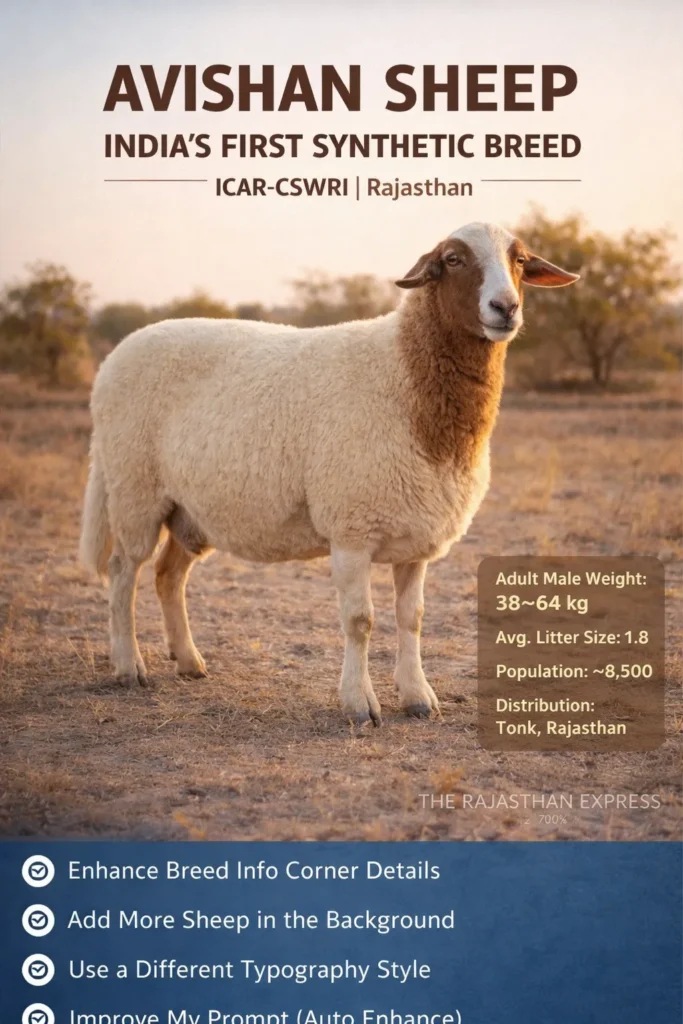
16. Avishan Sheep (First Synthetic Sheep Breed of India)
Avishan is the first synthetic sheep breed of the country, developed by ICAR–Central Sheep and Wool Research Institute (CSWRI).
This breed is known for higher prolificacy (ability to produce more lambs), higher total lamb weight, higher milk production, and adaptability to harsh climates.
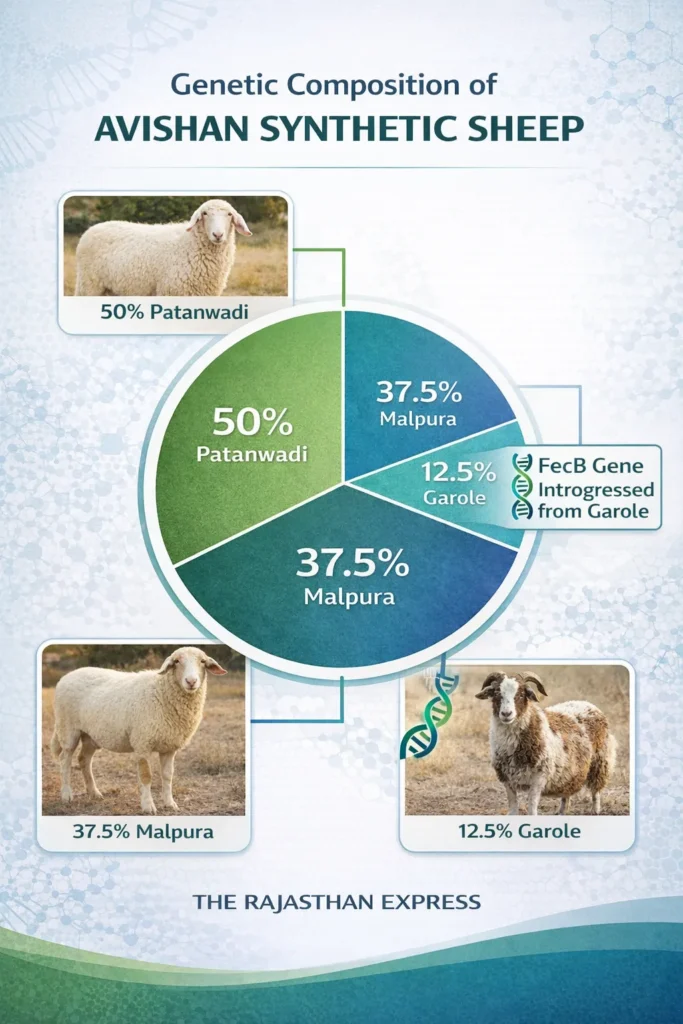
It is a composite cross consisting of approximately:
- 12.5% Garole
- 37.5% Malpura
- 50% Patanwadi
The FecB gene from Garole has also been incorporated, which is associated with higher reproductive ability.
It is a medium to large-sized mutton-type sheep.
Face Color: Light to dark brown extending up to the neck
Body Color: Off-white or cream
Nose: Roman type
Ears: Flat
Tail: Thin and medium length
Both males and females are polled (hornless)
Adult Male Weight: Approximately 38 to 64 kg
Average Litter Size: Approximately 1.8
Wool Type: Coarse
Main Distribution Area: Tonk district of Rajasthan
Estimated Population: Approximately 8.5 thousand
NBAGR Cattle Breeds: Indigenous and Synthetic Classification
Indian Cattle Breeds
- Total Indigenous Cattle Breeds: 55
- Total Synthetic Cattle Breeds: 3
Currently, there are 55 registered indigenous cattle breeds in India. They are mainly classified into three categories based on their utility:
1. Milch Breeds (Primarily for Milk Production)
- Example: Gir, Sahiwal, and Tharparkar, etc.
2. Dual-Purpose Breeds (For Milk Production and Agricultural Work)
- Example: Kankrej, Haryana, and Ongole, etc.
3. Draught Breeds (Mainly for Agricultural and Transport Work)
- Example: Nagori, Amrit Mahal, and Punganur, etc.
Global Classification of Cattle: Bos indicus vs Bos taurus
Globally, cattle are mainly classified on two bases: physical structure and utility.
A. Humped Breeds (Zebu – Bos indicus)
- Indigenous cattle breeds have a fully developed hump and are easily identified by it. For this reason, they are called Humped Cattle.
- Their scientific name is Bos indicus, and they are collectively known as Zebu cattle.
- Zebu cattle have a fully developed dewlap.
- Zebu cattle have fully developed and large horns.
- Although milk production is lower compared to exotic breeds, they have higher disease resistance and are well adapted to Indian climate and feed conditions.
B. Humpless Breeds (Exotic – Bos taurus)
- These breeds do not have a hump and are mainly native to temperate regions. For this reason, they are called Humpless Cattle.
- Their scientific name is Bos taurus.
- Exotic cattle have a less developed dewlap.
- Exotic cattle have less developed and small horns.
- They are known for higher milk production and are often used in cross-breeding with local breeds so that traits of higher production and local adaptability can be combined. Example: Jersindh (Jersey ✕ Red Sindhi).
| Indigenous Cattle Breeds of India | |||||
| S.N. | Breed | Home Tract | Accession Number | Link | |
|---|---|---|---|---|---|
| 1 | Amritmahal | Karnataka | INDIA_CATTLE_0800_AMRITMAHAL_03001 | – | |
| 2 | Bachaur | Bihar | INDIA_CATTLE_0300_BACHAUR_03002 | – | |
| 3 | Bargur | Tamil Nadu | INDIA_CATTLE_1800_BARGUR_03003 | – | |
| 4 | Dangi | Maharashtra and Gujarat | INDIA_CATTLE_1104_DANGI_03004 | – | |
| 5 | Deoni | Maharashtra and Karnataka | INDIA_CATTLE_1108_DEONI_03005 | – | |
| 6 | Gaolao | Maharashtra and Madhya Pradesh | INDIA_CATTLE_1110_GAOLAO_03006 | – | |
| 7 | Gir | Gujarat | INDIA_CATTLE_0400_GIR_03007 | – | |
| 8 | Hallikar | Karnataka | INDIA_CATTLE_0800_HALLIKAR_03008 | – | |
| 9 | Hariana | Haryana, UP, Rajasthan | INDIA_CATTLE_0520_HARIANA_03009 | – | |
| 10 | Kangayam | Tamil Nadu | INDIA_CATTLE_1800_KANGAYAM_03010 | – | |
| 11 | Kankrej | Gujarat and Rajasthan | INDIA_CATTLE_0417_KANKREJ_03011 | – | |
| 12 | Kenkatha | UP and Madhya Pradesh | INDIA_CATTLE_2010_KENKATHA_03012 | – | |
| 13 | Kherigarh | Uttar Pradesh | INDIA_CATTLE_2000_KHERIGARH_03013 | – | |
| 14 | Khillar | Maharashtra and Karnataka | INDIA_CATTLE_1108_KHILLAR_03014 | – | |
| 15 | Krishna Valley | Karnataka | INDIA_CATTLE_0800_KRISHNAVALLEY_03015 | – | |
| 16 | Malvi | Madhya Pradesh | INDIA_CATTLE_1000_MALVI_03016 | – | |
| 17 | Mewati | Rajasthan, Haryana, UP | INDIA_CATTLE_1705_MEWATI_03017 | – | |
| 18 | Nagori | Rajasthan | INDIA_CATTLE_1700_NAGORI_03018 | – | |
| 19 | Nimari | Madhya Pradesh | INDIA_CATTLE_1000_NIMARI_03019 | – | |
| 20 | Ongole | Andhra Pradesh | INDIA_CATTLE_0100_ONGOLE_03020 | – | |
| 21 | Ponwar | Uttar Pradesh | INDIA_CATTLE_2000_PONWAR_03021 | – | |
| 22 | Punganur | Andhra Pradesh | INDIA_CATTLE_0100_PUNGANUR_03022 | – | |
| 23 | Rathi | Rajasthan | INDIA_CATTLE_1700_RATHI_03023 | – | |
| 24 | Red Kandhari | Maharashtra | INDIA_CATTLE_1100_REDKANDHARI_03024 | – | |
| 25 | Red Sindhi | Organized farms only | INDIA_CATTLE_0000_REDSINDHI_03025 | – | |
| 26 | Sahiwal | Punjab and Rajasthan | INDIA_CATTLE_1617_SAHIWAL_03026 | – | |
| 27 | Siri | Sikkim and West Bengal | INDIA_CATTLE_2221_SIRI_03027 | – | |
| 28 | Tharparkar | Rajasthan | INDIA_CATTLE_1700_THARPARKAR_03028 | – | |
| 29 | Umblachery | Tamil Nadu | INDIA_CATTLE_1800_UMBLACHERY_03029 | – | |
| 30 | Vechur | Kerala | INDIA_CATTLE_0900_VECHUR_03030 | – | |
| 31 | Motu | Odisha, Chhattisgarh, Andhra Pradesh | INDIA_CATTLE_1526_MOTU_03031 | – | |
| 32 | Ghumusari | Odisha | INDIA_CATTLE_1500_GHUMUSARI_03032 | – | |
| 33 | Binjharpuri | Odisha | INDIA_CATTLE_1500_BINJHARPURI_03033 | – | |
| 34 | Khariar | Odisha | INDIA_CATTLE_1500_KHARIAR_03034 | – | |
| 35 | Pulikulam | Tamil Nadu | INDIA_CATTLE_1800_PULIKULAM_03035 | – | |
| 36 | Kosali | Chhattisgarh | INDIA_CATTLE_2600_KOSALI_03036 | – | |
| 37 | Malnad Gidda | Karnataka | INDIA_CATTLE_0800_MALNADGIDDA_03037 | – | |
| 38 | Belahi | Haryana and Chandigarh | INDIA_CATTLE_0532_BELAHI_03038 | – | |
| 39 | Gangatiri | Uttar Pradesh and Bihar | INDIA_CATTLE_2003_GANGATIRI_03039 | – | |
| 40 | Badri | Uttarakhand | INDIA_CATTLE_2400_BADRI_03040 | – | |
| 41 | Lakhimi | Assam | INDIA_CATTLE_0200_LAKHIMI_03041 | – | |
| 42 | Ladakhi | Jammu and Kashmir | INDIA_CATTLE_0700_LADAKHI_03042 | – | |
| 43 | Konkan Kapila | Maharashtra and Goa | INDIA_CATTLE_1135_KONKANKAPILA_03043 | – | |
| 44 | Poda Thurpu | Telangana | INDIA_CATTLE_3600_PODATHURPU_03044 | – | |
| 45 | Nari | Rajasthan and Gujarat | INDIA_CATTLE_1704_NARI_03045 | – | |
| 46 | Dagri | Gujarat | INDIA_CATTLE_0400_DAGRI_03046 | – | |
| 47 | Thutho | Nagaland | INDIA_CATTLE_1400_THUTHO_03047 | – | |
| 48 | Shweta Kapila | Goa | INDIA_CATTLE_3500_SHWETAKAPILA_03048 | – | |
| 49 | Himachali Pahari | Himachal Pradesh | INDIA_CATTLE_0600_HIMACHALIPAHARI_03049 | – | |
| 50 | Purnea | Bihar | INDIA_CATTLE_0300_PURNEA_03050 | – | |
| 51 | Kathani | Maharashtra | INDIA_CATTLE_1100_KATHANI_03051 | – | |
| 52 | Sanchori | Rajasthan | INDIA_CATTLE_1700_SANCHORI_03052 | – | |
| 53 | Masilum | Meghalaya | INDIA_CATTLE_1300_MASILUM_03053 | – | |
| 54 | Medini | Jharkhand | INDIA_CATTLE_2500_MEDINI_03054 | – | |
| 55 | Rohilkhandi | Uttar Pradesh | INDIA_CATTLE_2000_ROHILKHANDI_03055 | – | |
| The Rajasthan Express: Your Trusted Source for Animal Care and Veterinary Science. | |||||
| Synthetic Cattle Breeds of India | |||
| S.N. | Breed | Home Tract | Accession Number |
|---|---|---|---|
| 1 | Frieswal | Uttar Pradesh & Uttarakhand | INDIA_CATTLESYNTHETIC_2024_FRIESWAL_04001 |
| 2 | Karan Fries | Haryana | INDIA_CATTLESYNTHETIC_0500_KARANFRIES_04002 |
| 3 | Vrindavani | Uttar Pradesh | INDIA_CATTLESYNTHETIC_2000_VRINDAVANI_04003 |
| The Rajasthan Express: Your Trusted Source for Animal Care and Veterinary Science. | |||
Key Points About Indigenous Cows – FAQ
Which is India’s best draught (load‑carrying) cow breed?
India’s best draught (load‑carrying) breed is Amrit Mahal.
Which is Maharashtra’s best draught breed?
Maharashtra’s best draught breed is Khillari.
Which is Rajasthan’s best load‑carrying breed?
Rajasthan’s best load‑carrying breed is Nagori.
Which is India’s best dual‑purpose (milk + work) cow breed?
India’s best dual‑purpose (milk + work) breed is Hariana.
What is the world’s smallest cow breed?
The world’s smallest cow breed is Vechur.
What is India’s heaviest cow breed?
India’s heaviest cow breed is Kankrej.
What special gait does the Kankrej breed have?
The Kankrej breed exhibits a “Sawai Chal” (fast and special gait).
How was the Deoni cow created?
The Deoni cow was created by crossing Gir, Dangi, and local cows.
How was the Nimari cow created?
The Nimari cow was created by mixing Gir and Khillari breeds.
Which is India’s most expensive cow breed?
India’s most expensive cow breed is considered to be Ongole. In Brazil, this same breed is called Nelore. In early 2025, a Nelore cow named “Viatina‑19” sold for approximately ₹40‑41 crore and set a Guinness World Record. It weighed about 1100 kg.
When were Ongole cows first taken to Brazil?
The first Ongole cows were taken from India to Brazil in 1868. By 1960, about 7000 cattle were sent there. In Brazil, the breed was named Nelore after the Nellore district of Andhra Pradesh.
Which indigenous cow has the longest lactation period?
Among indigenous cows, the longest lactation period is of the Gir cow (about 325 days). The Gir cow originated in the Gir forests of Kathiawar, Gujarat. It is also called Kathiyawadi, Ajmera, Renda, Surti.
Which buffalo has the longest lactation period?
Among buffaloes, the longest lactation period is of the Mehsana buffalo (about 352 ± 15 days).
What are the key identification features of a Gir cow?
Identification of Gir cow: Red, brown, or spotted skin; prominence on forehead; long, hanging, leaf‑shaped ears; half‑moon shaped horns.
Which is India’s highest milk‑producing indigenous cow?
India’s highest milk‑producing indigenous cow is Sahiwal. The Sahiwal cow has a more developed dewlap and Nawelflap. It originated in Montgomery (Pakistan), Punjab, Haryana. It is also called Lola breed, Multani, Montgomery, Lambi Bar. Because its skin is loose, it is called the Lola breed.
Which is the most intelligent cow breed?
The most intelligent cow breed is considered to be Red Sindhi (also called Red Karachi). It originated in Karachi, Hyderabad (Sindh), Pakistan.
Which indigenous cow has the highest disease resistance?
Among indigenous breeds, the highest disease resistance is found in the Tharparkar cow, found in Rajasthan, India. It originated in the Tharparkar district of Sindh (Pakistan) and in Gudamalani, Barmer. It is also known as White Sindhi, Grey Sindhi, Thari, or Malani. The Tharparkar cow also has the ability to change colour.
Which cow is the highest milk‑producing cow in Rajasthan?
The highest milk‑producing cow in Rajasthan is the Tharparkar.
What is the Rathi cow?
The Rathi cow was created by mixing Red Sindhi, Sahiwal, Tharparkar, and Dhani breeds. It is also called Rajasthan’s Kamadhenu.